Columns On Writing Notes From Class
Writing Our Pandemic Stories: May & June
In this three-installment column, Chloe Caldwell and her 12-month essay generator students write about their daily life during the Covid-19 crisis
Caroline Shannon-Karasik (Pittsburgh, PA)
I have developed a crush on my fitness app instructor. She packs the high-energy encouragement I need to get moving within our 1100-square-foot living space. Wrapped in spandex and glittering sweat are her perfectly round breasts, two half-moons above her sports bra. The kind I envy. She asks, “Are you with me?” High on endorphins and soaked with sweat, I pant— yes, yes, yes .
At night, Dan and I watch Jodie Comer’s Villanelle on Killing Eve . We binge for Phoebe Waller-Bridge’s genius writing. We binge for Villanelle’s round eyes, perfectly arched eyebrows, dry sense of humor. She commands a room in a sheer, pale blue Burberry dress trimmed in white lace or a deliciously poofy pink frock. We are enamored with this psychopath, we agree. “I wouldn’t kick her out of bed for eating crackers,” Dan jokes. I wouldn’t either.
I told Dan I was bisexual in October, just two months before Covid-19 swept Wuhan, China. We were sitting on the kitchen carpet, while he rolled a bottle of insulin between his hands, the tap, tap, tap of his wedding band sharp against the glass. Ever since our cat Simon was diagnosed with diabetes, the carpet had become our gathering place. Twice a day, one or both of us sat brushing his long, black Maine Coon fur, encouraging him to eat just enough kibble before sticking a needle between his shoulder blades.
That night, Simon crunched his food while I traced my hands over the carpet’s woven, Berber-like texture. Bits of puffed cereal were crushed into crevices, remnants of our daughter’s afternoon snack. Dan poked the needle into the bottle, pulled back on the syringe. It was another quiet window between us where I felt a stirring in my belly, a rising in my throat. Like pregnancy nausea mixed with Pop Rocks.
“I’m pretty sure I’m bisexual,” I blurted, tears fast down my cheeks. “Not pretty sure . . . I am.”
“OK, and that’s it?” Dan said.
“What do you mean that’s it ?”
“Honey, you just seem so embarrassed,” he said, reaching for my hand. “I’m not saying that’s it , like that. But we’ve got this—we can do this.”
“I’m so scared,” I said. “I still want to be with you.”
“Then be with me.”
It was the approach we had always taken during our fifteen years together. “Still want to be together?” Yes. It was a check-in of sorts. We married knowing a relationship’s imperfections meant a future wasn’t guaranteed. Postpartum depression, job loss, and parenting had all tested that. Dan and I kept choosing each other. We knew the possibility of other love—or simply attraction—existed. For me, that just now openly included women.
Social distancing began on the heels of my coming out, but I have never felt sexually freer within the confines of our home. I tell Dan about the swirling, fizzy feeling I have for fitness woman’s magnetism, Villanelle’s unapologetic sexuality, and I don’t feel shame. It feels like a long-missing piece of our marriage, finally in place.
It feels like my husband’s hand on mine.
*
Diane Ostrom (Flemington, NJ)
In November, our troubles came to us nested like Russian dolls: My mother needed minor leg surgery that had been put off by my father’s ever-worsening dementia. When we had, at last, constructed a small universe of helpers to watch over him as she convalesced, her doctor revealed, just hours before that surgery—her IV already in, her gown on, her pre-surgical blood work completed—that she wouldn’t be having it after all. First, she would need months of chemotherapy, to address a long-dormant form of leukemia, suddenly more apparent. Surprise!
My father died ten days later. Had the surgery proceeded, my mother—the former nurse, the one who knew when to call the doctor and when, instead, to call hospice—would have been sleeping off Tramadol in her hospital bed instead of home with him during those last, precarious days.
Four days after he died, she returned to the hospital for chemotherapy, and made it three hours until I returned from Panera, a paper bag of Bacon Turkey Bravos in my hand, to find her sequestered behind a coral-colored sheet, having thrown up all over the floor. On her way home, my mother, who had taken precisely one Tylenol after breaking her leg a year earlier, said: “I don’t think I can do that again.”
“You have until a week from today,” I said.
We went back, and saw Marilyn.
Or Marilyn saw me first. She had been my mother’s boss thirty years ago, when they both worked for the local Girl Scout council. She had been a fixture of my childhood, encouraging me to apply to attend the National Girl Scout Convention that Maya Angelou keynoted. She was a year older than my mother, something between a friend and a colleague.
Marilyn had colon cancer and was midway through her second round.
“It’s not going great,” she said, shrugging.
As I left to run errands for my mom, they shuffled their seats around to sit next to each other. They had not been close in recent years, but they were in the same foxhole. Though she could have left an hour earlier, Marilyn stayed with my mother until her treatment was over.
“That was lucky,” my mother said as we walked to the car, despite everything.
We live in New Jersey, the state second-hardest hit by the pandemic, and I know many people who’ve had the virus, both here and elsewhere: an ex-boyfriend in London; another ex-boyfriend, his wife, their daughter, and their two sets of parents; my boss and her husband; a friend in France; a friend from school; another friend from school; and another dozen others. Marilyn is the only person I know who died.
I think of her now, in the waning days of whatever this is, first wave or last, whenever a reporter or government official clarifies the risks as reserved for the elderly and the ill. In that assuaging is something curdled and treasonous, I think: In that subtext, the unspoken This isn’t for us issued to the hale and the hearty, the minority among us to live in perfect isolation and perfect health.
The measure of the horror of this moment, and there are myriad, is in the cajoling, the mumbling, the cowardice of this new language; dismissing the infirm, the aged, and the unlucky to their deaths—or to their luck, whether it be good or bad. Marilyn was unlucky, and now she is one of 100,000 dead. A cataclysm. After the shock comes the stocktaking, and when that comes, there should be no forgiveness for those who consigned them to it.
*
Amanda McNeil (Milwaukee, WI)
After two months of quarantine, I’ve created a new practice I’m not sure I can ever give up. Every morning, I make coffee and listen to a vinyl record in it’s entirety, a ritual I previously felt too rushed for when I had to do dumb shit like put on pants, bras, and makeup to do my job. I play Waylon Jennings, Bun B, Patsy Cline, The Mountain Goats, Dolly Parton, and NWA while I wait for my coffee to brew. Then I can add heavy cream and too much Splenda. I sing and dance, grateful my downstairs neighbors haven’t moved in yet and turned this morning routine into routine humiliation.
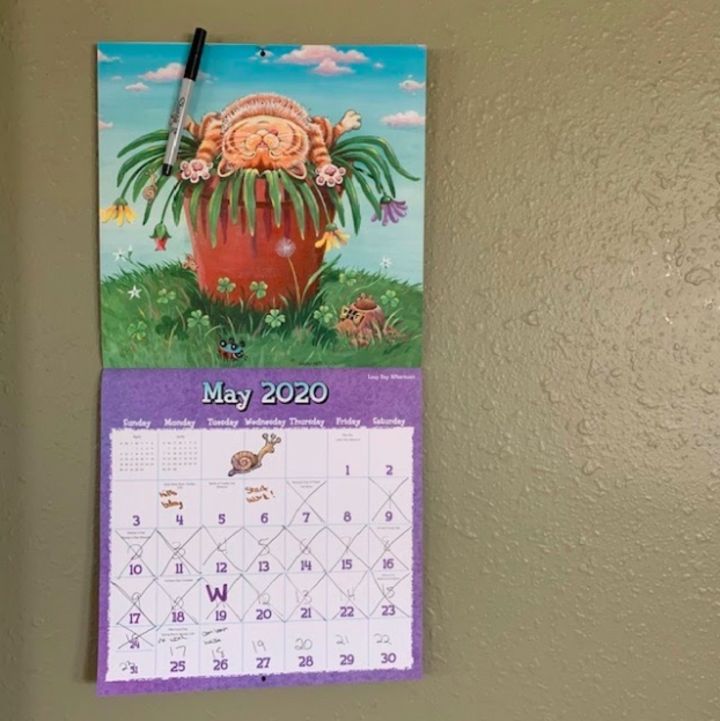
Without the temptation of office snacks and dinner invitations, I’ve been trying to wrangle my eating disorder into submission. I read from my Twelve-Step Program’s daily readings while I take my post-coffee poop. Before I go to bed, I mark the days I don’t binge with an “X” on a calendar hung in my kitchen. I decide I won’t leave the house until I have fifteen days. When I hit five days on the 13th, I contemplate moving the goalpost to thirty, or only reemerging once the world is safe from the virus and I’m a person with a healthy relationship to food. Both seem impossible and far off.
On May 14th, the Wisconsin Supreme Court strikes down the Safer at Home order, and a secondhand embarrassment I haven’t felt since I lived in Texas and George W. Bush was President pours over me. I panic at the thought of going back to an office every day and giving up my morning performance of country classics. Venturing out into a world where I’m confronted by all of my trigger foods again feels terrifying. The relief I feel when I learn Milwaukee is still under a shelter in place order can only be expressed by belting out Dolly’s “Dumb Blonde” in my kitchen to an unenthused audience of my cats.
Our class is on break right now. These few hours on Sundays have become crucial for me. Class keeps me accountable and inspired, gives me a reason to shower and put on a clean set of pajamas. I worry I’ll slack off without it, and my hair will tangle into an impenetrable rat’s nest.
We schedule an informal Zoom meetup the Sunday after the Supreme Court reopens most of the state. I shower beforehand, and even put on eyeliner. A large portion of us are able to show up, and we spend the time talking about our lives, writing, books, and how we’re struggling during social distancing. I laugh harder than I have in weeks. When we all sign off, I’m in physical pain from holding my bladder for so long, not wanting to miss a minute with these hilarious, smart women. I count down the days on my calendar until our next meetup.
* If you would like to read the first installments of Pandemic Stories, you can read March & April here and April & May here .