Columns On Writing Notes From Class
Writing Our Pandemic Stories: March & April
In this three-installment column, Chloe Caldwell and her 12-month essay generator students write about their daily life during the Covid-19 crisis
Chloe Caldwell ( Hudson, New York)
April is historically the month my life shifts, and this year is no exception, except it isn’t the shift I envisioned. When I wake up on my thirty-fourth birthday, the rain is hammering. Among my first thoughts: How many people died between the time I fell asleep and woke up? Also: I’m supposed to be in Israel on a storytelling, networking, and leadership trip. Neither of these are productive thoughts.
On Sundays, I wear jeans and blouses. I wear jewelry and makeup. I have writing class with ten brilliant women. Had life continued as planned, I would have been working on planes and trains and in the airports (which I like doing), now it has become something else entirely. It’s my social life, they are my people, and it is what punctuates the passage of time.
On Sundays, I have a purpose, somewhere to be, and how lucky are we that in the midst of this, we come together for three hours from Los Angeles to Madison to Pittsburgh to Columbus to San Francisco to share life experience and stories.
On Sundays, we attend the essay generator class religiously, like a fucked-up version of Church, because everything we are told in the real world to be quiet about, we have to be porous about in writing. Writing creative nonfiction and personal essays involves a decent amount of unlearning.
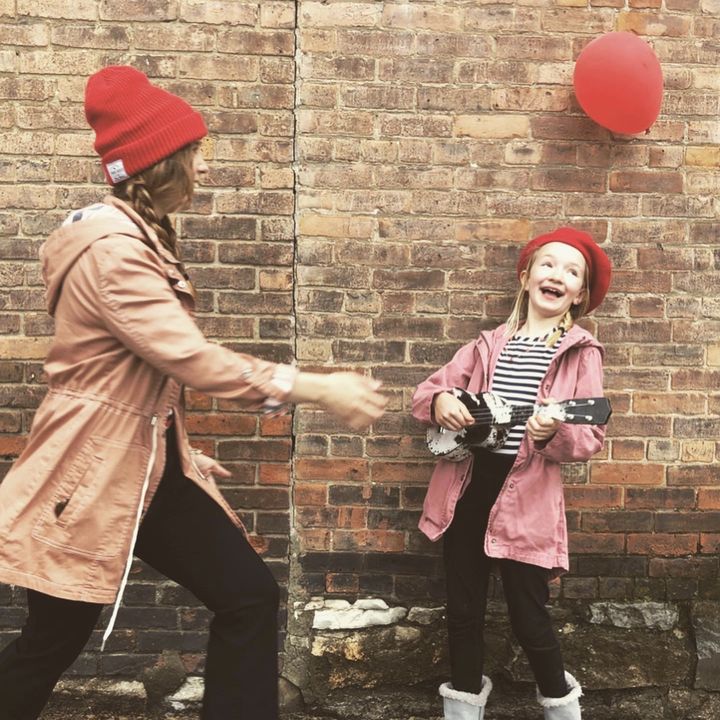
My stepdaughter and I learn Broadway dances: “Hard-Knock Life” from Annie , “All That Jazz” from Chicago , “Jellicle Cats” from Cats , “We Go Together” from Grease . She orders Betty & Veronica comics online and asks me to order Deenie . She creates origami boxes as she watches her favorite Gilmore Girls episodes over and over. My husband plays “I Will Survive” in ragtime on his piano downstairs.
On my mom’s birthday (also Aries), the three of us dress up French and surprise her in the driveway singing Champs-Élysées—the same driveway we walked up a year ago when my husband and I were married.
The texts I receive now are mostly “Wanna go on a walk,” and I walk with my photographer friend JD Urban to the river and back. To the river and back. Sometimes, I do this three times in a day. Sometimes we stop for a drink at the window of the BBQ restaurant American Glory. The girl serving us says it’s the law to give chips with our drinks. She holds up two bags: Fritos and Doritos. My friend asks me which I want. These are the decisions we make now. Sometimes, my students send me photos of where they are while taking my class. This is where I live now. On a screen.
Walks are a way to structure the day, and now my husband and I count our steps just for something to do.
Some succulents I’ve had for two years and have never grown are finally looking healthy and thriving. The Christmas cactus which didn’t bloom during Christmas has bright red buds.
When we talk about writing, we say things like “zooming in” and “zooming out.”
Zoom zoom zoom. Will any of us ever look at the word “zoom” the same way again? The irony of “American Glory” just now dawned on me.
*
Stephanie Dinkmeyer (Canonsburg, PA)
I can hear my husband coughing downstairs.
I sit down to write because I have a class deadline. I sit down to read because we will be discussing the reading. We are learning about the difference between the situation and the story in personal essay writing. The situation is what happened. The story is, “What do you want to say about what happened?”
The situation is a virus morphed inside a bat or a snake or a pangolin we don’t know, leaving 115,000 dead as it makes its way across the globe. It will be thousands more when you read this.
The situation is I haven’t hugged anyone except my husband in six weeks. They are long, grateful hugs. They are long and grieving sometimes. They are brief and hollow other times, with a space inside them that shows that being alone has nothing to do with bodies.
The situation is silence. I measure social distancing in my neighborhood by hearing how many car doors shut on a daily basis, people coming home. Three or four. The gag is: We are already home.
The situation is my introversion in full bloom, thriving. Guilt at the internal blooming, the way I feel soothed by the lack of social pressures. The way it is slow and I really, really like that it is slow.
The situation is I have become cat furniture as I watch the Sopranos for the fourth time through.
My mom just FaceTimed me from Florida to tell me she’s going to cut her bangs. I wonder if I put my ear up to my cats I will hear the ocean.
The situation was fourteen days in early March. Josh had fevers, coughing, coughing so hard he puked, sweating, rudderless sleeping, small shallow breaths that seemed to only reach the back of his throat. Moderate. I had achy sleepiness, a cough, a blah-ness. I tried to eat an orange, and it was just texture. Mild. No tests available. The situation is we are still here in April.
The story is that this will change us deeply. There will be less of us in number, and we will have been chipped away at and ground down in other ways.
The story is how unsettling it is to enjoy the silence and to wish the cost of it wasn’t so high.
The story is that we keep going, those of us that can.
The story is grief.
Joan Didion said she writes to figure out what she thinks. I don’t know what I think, either. Especially now. Before, I was often dumbstruck with perfectionism, the lie of knowingness. But now, there is nothing but misty space and time, nothing but rich unnamable change (it is loss, I think?) to dig through.
Tonight, we sat on our porch in the darkness, as dark as a suburban block can be, sitting next to each other, directly facing our neighbor’s front porch which was empty. Right above it was a constellation; I’m not sure which one. It looked to be in the same plane as their home. It looked like it’s never been closer. I heard a neighbor’s front door close.
*
Raena Zupan ( Columbus, Ohio)
Because of the coronavirus, my state has been on lockdown since last month. It’s a very bad time to check-in to a nursing home.
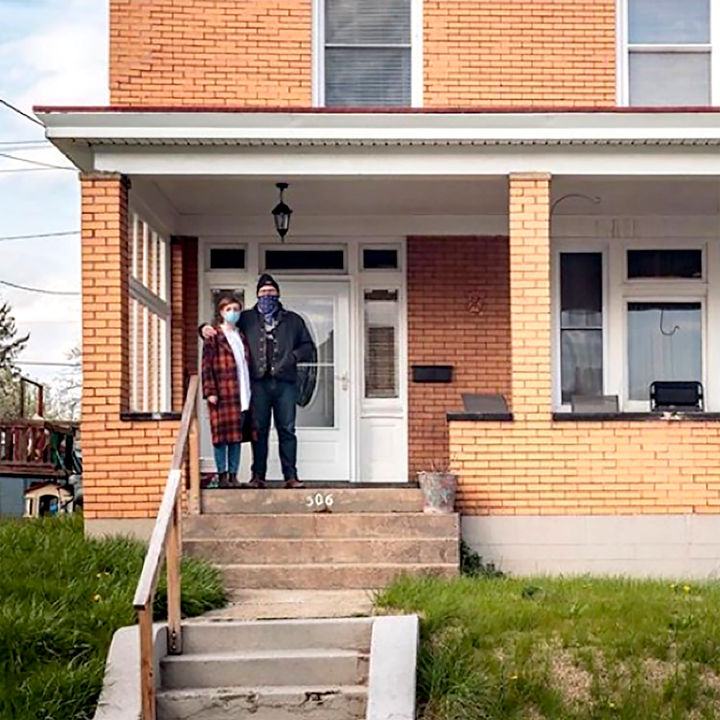
My fiancé, Arin, can’t visit either of his parents right now. In recent weeks, they’ve had to enter skilled nursing facilities. First it was his mom, Pam, who recently had a liver transplant and needs medical care while she recovers. Next, it’s Tony, who winds up in a different facility because of his vascular dementia. We believe both will be discharged soon.
Pam and Tony have been married for fifty-three years, and I’m sure this isn’t easy. However, even if they had a way to visit each other, it’s forbidden right now. No exceptions.
Arin is the first to get the news. Pale with panic, he waves me over. A nurse has called about his dad.
“They can’t revive him!” he says, frantically, looking like he might fall over. Revive him? From what?
“Stay near the phone,” instructs the nurse.
The second call comes right after. And just like that, we’re informed that Tony has passed away.
I don’t understand. How could this happen?
“We think he had a heart attack,” says the nurse. Why is she so calm? “We tried CPR. That’s all we know right now.”
I drive. We have to spring Pam from nursing home A, then go to nursing home B.
An aide brings her out in a wheelchair. “She is seriously immuno-compromised,” she tells Arin, as though he didn’t know this. “ No hugs. And the mask stays on at all times.”
“One last thing,” she adds. Since Pam is “choosing to leave the facility,” the cost has now increased by four hundred dollars per day since they’ll need to quarantine her.
“What do you mean, for the quarantine?” Arin asks. “She hasn’t even been allowed to leave her room! Are you saying that’s not a quarantine?”
“It’s a brand-new policy,” she says, wishing she could take it back. “I’m so sorry. I don’t have an answer for you.”
“Do not talk to her about money,” Arin tells her as we leave.
Entering nursing home B is a complicated process.
Arin, Pam, and I meet the rest of his family outside. A nurse comes out and hands us each a packet of protective gear.
It is not easy to get into a paper robe in the wind. “What the hell good is this supposed to do?” asks Arin’s brother, searching for the sleeves.
“It’s like a Snuggie made of tissues,” Arin chimes in. He’s not trying to be funny, just stating the facts.
I wait in the hall while the family goes in, two at a time. It’s the first time they’ve seen Tony’s room.
The same nurse keeps offering me cocoa. I don’t want to be rude. But what about the mask?
Tony didn’t have COVID-19, but because of the pandemic, he died in isolation. The rules are essential—I know that. This is just a lot to digest. The whole family wanted to visit, yet he spent his final hours, days, and weeks on his own. Loved, missed, always top of mind. But alone.
I hardly knew him. But I can see what this is doing to his family; how they’re scrambling to retrace their steps.
“I could’ve gone to his window,” Arin says later. “To visit him. Should I have done that?” He pauses. “I think he would’ve hated it.”
“Yes,” I reply, “I agree. I think anyone would hate that.”
*
Allyson Darling ( San Francisco, California)
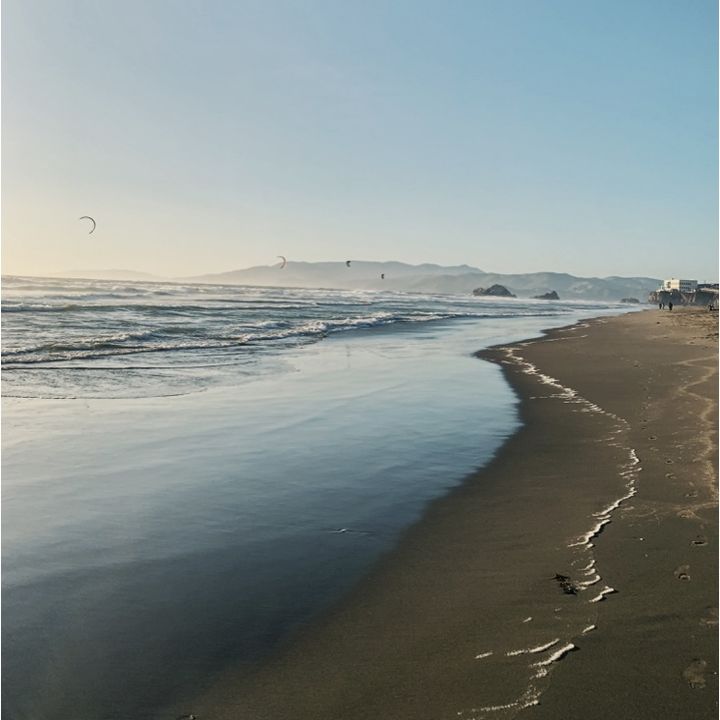
We’ve spent almost nine hours in a studio apartment, and we need to see something big. Away from people and masks over mouths, smile-hiders, and people dodging each other on the San Francisco streets whose sidewalks usually have more company than this. We drive to the ocean and walk barefoot over the dunes of sand like we’re in a cold, cold windy desert.
The wind is fierce. I wear the warmest jacket I have and it’s still not enough, but I don’t care because seeing a force as big as the sea after spending the day, and most days, in a 350 square-foot space—turning the heater on and off, climbing in and out of bed, taking meetings from my sweatpants is enough.
We fought about a TV show this morning because we’re just hungry for something to do. Someone I know got mad at her partner for using his fork too loudly, and I get it.
We try to catch sand crabs when the waves pull them out and watch kite surfers. No one goes anywhere near each other, the sand is kind about that. Vast. We discuss hugging people when it’s all over and how we can’t believe we used to be allowed to go to concerts. The idea of standing in a crowded concert, front row, beer spilling on my feet, heart vibrating, singing along, feels like bliss.
Most days, I move the table from the kitchen into the living space, work until five, and go on some sort of adventure in the city: a hill-climb, sunset-watch, sand crab-catch, and then we just “suppose.” We suppose when we’ll see our friends again. When it will be over. What does “over” mean. Will we be able to go to Italy in May? I’d be content for a loud Italian restaurant at this point.
There is a calm beauty to these days that have now become routine that I’ll miss. And there’s a horror to it that I won’t miss. There’s a sweetness to waking up next to my partner in the mornings and taking turns comforting each other through breakdowns and having the spaciousness of time. To eat mushrooms and watch the trees in her backyard breathe. To watch the sunset every night. To cook the hard recipes. To cook the easy recipes. To cry and laugh about nothing. To laugh-cry. To participate in the act of longing—for people and places and contact and connection and things I never thought I’d miss, like public transportation. Like big birthday dinners.
We’re moving in together next month and what a funny time to move but what a funnier time to live in two locations, driving back and forth across the Bay, no traffic, a forty-five-minute journey now taking seventeen.
Back in my neighborhood now, I can’t wait to buy a bottle of seltzer at the shop next to my house—the one with a cat named “Dog.” I’m too late, though. I’ve forgotten it closes at eight now. Weighted by despair, I’m in near tears, but I know it’s not really about the seltzer.