People Performers
Piano Women: The Artists Who Helped Me Subvert the Music Industry’s Obsession With Categorizing My Body
The day-to-day negotiation I faced as a mixed-race woman made me resist the idea that classifying myself and my body was the only way to get my music heard.
“Alicia Keys!” was the first thing men said on hearing my songs, snapping their fingers, as if it took originality and record label savvy to get that sum from light-skinned girl plus piano. I’d sat through enough industry meetings not to be surprised by the comparison, but it still made me flinch—mostly because it was inaccurate. My songs owed no debt to R&B or soul; they were built on the dark and storm of ninth and eleventh chords, while Alicia kept things at a minor seventh or simpler. Her songs had hooks to hang a chandelier on; mine carried torches. Her piano phrases would erupt into twinkling arpeggiated flourishes, but you’d only know about my classical training if you asked. I had no gospel-style glissandos. No synth-y swish of the 808. And still these men would nod meaningfully to the rhythms of my songs like something profound was occurring, before they slapped the table and declared, “Alicia Keys!”
At some point, every artist has to reckon with the music industry’s logic of taxonomy. Responses vary based on clarity of vision and mercenary self-interest. A guy I used to see at open mics just dropped his first single. He’s in his early twenties, but has been on the music grind for a decade—the length of time they say it takes to make it. For the five years I’ve known him, I have never seen his stance on genre waver; each accoutrement—bluesy piano chords, warbling falsetto, blue eyes, blonde eyebrows—fits into the next with a confidence recalling the preordained rightness of a jigsaw. His song is the kind of white-boy R&B-lite I wish I was allergic to, but like I said, the kid’s put the time in: It’s a tightly-crafted, spongy little slow jam that preloads in the search tab on my Apple Music, even if it’s not allowed into my library.
A more interesting solution to categorization is the one Alicia Keys enacted: Burn the categories down. Her 2001 debut, Songs in A Minor, opens with then-nineteen-year-old Keys ordering the engineer to “flip it” as a snare-driven beat kicks in under Beethoven’s “Moonlight Sonata.” That snare hisses insistently through the entire record, threading together the classical runs, the gospel choir, the East Coast hip-hop; the sounds of someone young and hungry fusing multiple traditions in self-expressive alchemy. Her innovations make it all the more disappointing that record executives reduce her to type, citing her name like it’s the inevitable comparison if you are female, mixed-race, and classically trained.
My own survival strategy was one of attachment. Rather than facing the problem head-on—that I did not want to produce work that conformed to genre—I took refuge in active emulation, modeling myself after a series of female singer-pianists: Fiona. Nina. Tori. Not Alicia—though Songs in A Minor was a touchstone for me. Trying on various musical identities was a function of my fandom, but also an act of self-protection: In my mid-teens, not yet comfortable with my biracial identity and the scrutiny it provoked, the thought of affixing to my work a generic label felt akin to stamping ᴘᴏʟɪᴄᴇ ᴍʏ ʙᴏᴅʏ on my forehead.
photo via rufusowliebat/flickr
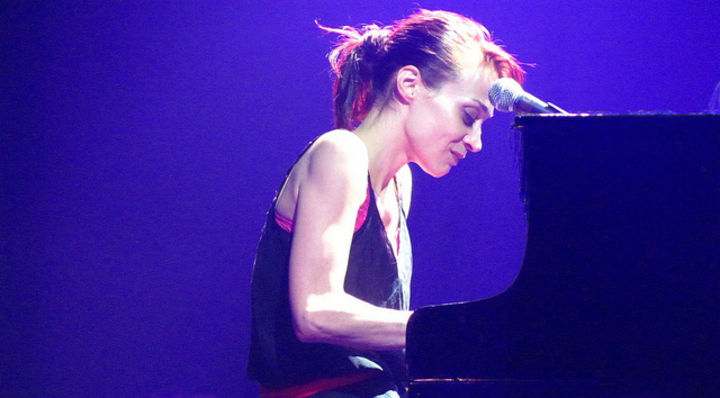
Fiona Apple was the first artist to whom I properly attached myself. I heard her name at one of my earliest gigs, when I was fifteen and sneaking into bars to hide behind my keyboard in the corner, playing sets full of original pieces I didn’t love. The problem, in my mind, was the finite number of chords in the world. Each time I fixed them in a new order, I crossed another combination off the list—and I wanted compositions built on chord progressions that matched those of no other melodies in the universe. This obsession with novelty meant that my body of work—which by then was only about a dozen songs—had next to no through-line. A different artist could have written every piece. Even the notion of genre was too abstract at that point. I was more concerned with the raw material of songwriting, which felt like a shrinking toolbox from which I couldn’t figure out how to fashion myself. At the end of one such show, an acquaintance came up to me and, perhaps because she heard in my work the lack of guiding principles, prescribed two names like a new workout plan: Fiona Apple and Regina Spektor.
The links between their work and my own, I later found, were fairly tenuous—not much more than “female,” “piano,” and “outside of genre”—but I was receptive to this comparison, being placed alongside women who shared my instrument and interests rather than just some physical features. I didn’t really vibe with Spektor until later, but Fiona’s work knocked something loose in me at once. I felt in her songs the essential inevitability that characterizes all great work, but my enjoyment, at least at first, was soured by my conviction that she’d somehow beaten me to it. We shared so many of the same building blocks—a weighty left hand, a distrust of genre, a taste for turns of phrase that glittered with Nabokovian showiness—she’d just hit on the more astute arrangement; one that, had I tuned in more closely to the fickle frequencies of composition, I felt I should have produced myself.
But envy passed into identification, which eventually became untainted appreciation. The songs that date from my Fiona Apple phase are weighty with piano parts that favor the low end and the left hand. My pieces grew long and ponderous, with enigmatic titles that might appear in the lyrics but aren’t central to the chorus. The vocals are breathy and low, unable to mimic Apple’s contralto but still inflected by its dusk. To hear Fiona’s blurred handfuls of notes was to suddenly realize that potential chord combinations were infinite. Songs like “Sullen Girl” and “Never is a Promise,” from her 1996 album Tidal, wander through chord shifts that flout the standard rules of changing key. And as much as her vocals court your attention, the album is a solid two-hander between voice and piano—the menacing chords that open “Shadowboxer” invited me to unlearn everything about phrasing I’d been taught in music lessons and just hammer away.
For a while, I was effectively a Fiona Apple impersonator who was in denial about it. But as I wrote more songs, sifting out those aspects that felt inauthentic—like mid-song tempo shifts or impenetrable syntax—large chunks of imitation fell away and the contours of my own artistry began to come into focus. I tightened the screws and developed my own bad habits. I started to think about the ways that my songs were in conversation with one another; how they could be ordered for maximum impact in a set or track list. I shored up these bits of consistency as a sign that I was coming into my own.
Then there were the meetings with men. I thought I’d hit on the ideal reply to shut down the Alicia Keys diagnosis—“Actually, Fiona Apple”—overlooking the fact that as Apple, too, was mostly untethered from genre, her name was only a partial solution. Invoking her gave little shelter from the larger question: What shelf do you see yourself on? It was a demand that opened up a host of others, ones I felt were purposely missing the point— What sort of outfits do you wear on stage? Can you wear your hair bigger? Why don’t you make more eye contact with the crowd? How about getting out from behind the piano, making it all a little sexier? How is this going to sell?
The problem with these questions was that they were all visual. To commit to a genre is to preempt this kind of cross-examination by showing that “image” is something you’ve already spent time thinking about—you’ve done the work so your listener doesn’t have to. The audience, as this line of thinking goes, should be able to see you, hear you, and thereby slot you into a preexisting musical schema (a reductive view more prevalent when dealing with major labels, rather than when an artist strikes out on her own).
But if you know intimately the day-to-day difficulty with classifying yourself and your body, a negotiation I faced as a mixed-race woman, then you’re going to be suspicious of anyone who tells you that doing so is the only way to get your work heard. In an interview with The Guardian, Moses Sumney—whose 2017 album Aromanticism, a stunning ode to singleness, braids genres with high drama in what sounds like a deliberate finger to categorization—shared his frustration with being called “an R&B artist,” as that particular label is the one that most “feels like a visual identifier as opposed to an aural [one].” Sumney’s words remind us that the imposition of genre can be an act of redirection, an excuse to look away from the work and instead at the body, a rerouting that left me perpetually offended.
Meeting after meeting, I received the message that my songs were not the point. The point was that to see and hear me—and to reconcile the former with the latter—demanded too much labor from the listener. I walked into so many offices ready to discuss my demo or, if there were a piano nearby, to arrest my interlocutors with the live renditions. But every conversation arced toward the same two dead-end options, both in the name of profit: The first was to go several squares back and rewrite my work, either by leaning into the racialized tropes of genre (“throw a beat on it”), or by engineering an earworm so hooky that genre would cease to matter altogether. The second—and the one that was presented to me far more often—was to signify a similar shorthand with my body: Ape Alicia and wear a fedora. Dress “like Prince’s sexy female drummer.” The link between look and sound wasn’t strong enough to hold; one of them was going to have to change.
I tried to develop a vocabulary to work around some of these questions, a cache of words that suggested certain generic affinities without binding me to any real conventions: the cop-out catchall of “alternative.” The deceptively uninformative “singer-songwriter.” The simultaneous having and eating cake of, not “jazz,” but “jazz y. ” If pressed, this last genre was the one that was most important to me. I would always soften it with the extra letter—I felt like I didn’t have the technical proficiency to back up a legitimate claim to jazz. If I couldn’t even properly produce work in that vein, how would I stand up to the barrage of questions that would follow? Wasn’t jazz even “sexier” than whatever I was doing? What, as a jazz artist, would they demand that I wear?
Jazz was also a path down which Fiona Apple was my unlikely first guide. Though she mostly evades classification, “jazz” is a common label that gets thrown around when people talk about her work. It’s one that she invites, if not claims: She borrows its slinking bass, its sevenths and ninths, its world-weary timbre. Though she takes just enough from the genre not to obscure her other sources—the alt-rock snarl, the hotel-bar shuffle—her proudly worn jazz influence was the element of her work that I most comfortably and keenly emulated.
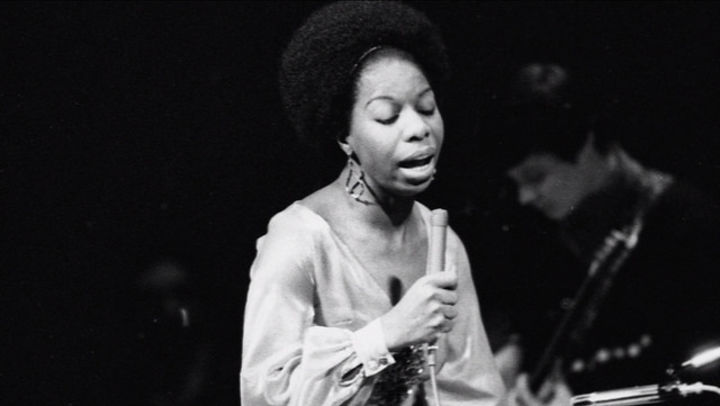
It’s hard to admit that my route into a historically African American genre was by way of a white woman; harder still not to think of how my artistry might have developed differently if I’d fully fallen into Nina Simone’s work earlier, once it occurred to me that drawing on jazz was irresponsible without some knowledge of its history and theory. I bought the two-disc Nina Simone Gold set and put it on in my bedroom, cranking the volume so it would reach me while I cleaned the bathtub. I was initially caught off guard by the texture of her voice, the way that something so rounded and heavy could also cut. Four tracks in, “Don’t Let Me Be Misunderstood” had me flitting back and forth between rooms before I gave up on the tub.
photo via Classic Film/flickr
So much distance existed between our artistic approaches: I had taken Apple’s seven-minute torch epics, added finger-gymnastic interludes, and was disproportionately proud to have no backing band. To listen to Nina was to be embarrassed by that stance. Whether playing solo or with others, she approached the instrument with a quiet power that was no less commanding for its minimalism. The insights I took from Nina’s work are ones that, even though I’ve left the industry, still shape every phrase I write: Make it feel preordained. Let it breathe.
If Fiona’s sensibilities were a mantle I slid inside with ease, I didn’t feel worthy of Nina’s. I’d sometimes cover her work at a short-lived restaurant residency where I played the part of musical wallpaper, but even in front of an audience more invested in chewing, I sensed the space between my attempts and true justice done to the work. There’s no way I found to convincingly replicate the multivalent consciousness that animates “I Put a Spell on You”—the tinkling, between-phrases piano that feels simultaneously detached from and deferential to Nina’s vocals; the shivery dialogue of desire between her and the sax solo, the two stuttering back and forth in mutual desperation; the overstuffed phrases of “Don’t Let Me Be Misunderstood,” her voice skittering just ahead of the beat before catching up at the end of every line.
I am grateful that my resistance to genre led me to seek shelter in the works of other women, as their songs enlarged my sense of permission for what constituted my personal narrative. But with Nina, I wish I’d not hidden behind a lack of technical proficiency. I wish I’d taken it on faith that it would follow organically if I gave myself to her work the way I gave myself over to Fiona’s.
Instead, I held her at arm’s length, worried that active emulation might cause a new diagnosis: “Nina Simone,” they’d say, and the old cycle would begin again. I feared giving people another tool for eclipsing my work. The fear was unfounded; anyone gunning for profit will never analogize a classic artist as fast as they will a contemporary superstar. But I’d internalized the shape of industry meetings, and denied myself the opportunity to grow.
It was my recognition of such intense self-policing—and how that made it almost impossible to create for pleasure—that led me to leave the music business. A piano is still the first personality I’m drawn to in a room, but only if it’s nestled in a corner; if it’s up on a stage, I tend to hang back, choosing to remain entirely myself.