Places Family On the Road
Traveling With My Parents Taught Me “Growing Up” Is Not “Growing Old”
My parents were old. It was time to take seriously the last years we had left. That is not, of course, how they saw things.
The boat lurched, and my insides responded in kind. A sound came from behind, like a woodpecker drumming away, full-bodied and sonorous. It was coming from two older tourists. One had her mouth open at a corner, eyebrows arched in what appeared to be a very painful slumber; the other had a little frown, thick eyebrows furrowed into two mellow slopes. I turned quickly around in my seat and took a photo. I sent it to a group chat.
“Good one,” my brother wrote back.
An announcement came on: The ferry would soon arrive in Busan, South Korea. My parents snorted awake. My mother closed her mouth, looked around, and smiled through her glasses and unflagging cheer.
They had good reason to be tired. They were in their early seventies and jet-lagged from the United States. The night before, they were dragged from airport to hotel to dinner by their youngest daughter, who was currently hustling them to a different country by boat.
When I picked up my parents at Fukuoka Airport, they launched their suitcases into the priority section of the subway car. “We’re seniors!” my mother said, a status she’d relished since the first time she could claim a discount ticket at the movie theater.
“You’re in Japan now,” I said. “You’re not old here.”
I did some more fretting about the week to come. I was to serve as tour guide in a language I’d been studying for only two months, to a discerning couple who thought Germany was boring and Japanese food was bland. But seeing my parents in Japan—which has the world’s oldest population, and where I’m routinely outpaced by slight, white-haired hikers swaddled in Gore-Tex—I wondered if they were slowing down at last, if my slapdash itinerary might stretch them thin over the next week. Nonetheless, I led the way to Fukuoka’s riverside food stalls, where we ate mediocre ramen and chortled with the hostess, who turned out to be from Vietnam, like us.
The next morning, our three-man parade continued at a clip. My parents came to my apartment, where my father attempted to fix my balcony screen and my mother commented on the loose strands of hair fallen in gentle punctuation on my floor. I took them to a shrine and a Japanese garden in the park. When it was time to catch the ferry to Busan, my mother gave a short hm! —her sound for disappointment.
As we flagged down a taxi, she said, “We’ll have to come back next time.” Next time?
There were a few things about this that would have struck a young me as odd: First, the fact that I lived in Japan; second, that I was in my thirties and traveling alone with my parents; third, that we were taking a cab; and fourth, that it had been my father’s idea.
When I was growing up, my parents were a very specific type of frugal. Many things that seemed routine for middle-class people were deemed luxuries: a sixth shirt when five got you through the week just fine; shaving cream, which was no better than bar soap; a haircut done by anyone other than my mother. I went away once for three weeks to summer camp (that is, a sleepaway writing course); as my mother handed me a twenty-five-dollar prepaid calling card to phone home, my father looked on with disapproval.
“It’s three weeks,” he said with impatience. “This is unnecessary.”
My two sisters, twelve and fourteen years older than me, were dressed in clothes from Goodwill when my parents first settled in Madison, Wisconsin, as refugees of the war between the US and Vietnam. My mother had arrived in the country carrying two taels of gold, which she sold for about $1,700 in today’s dollars. When bell-bottoms came back in their modest ’90s cuts, the fact that I already owned pants that did all that pants needed to do (cover legs and waist) was made abundantly clear. When I somehow managed to procure a pair, I wore them to school Mondays, Wednesdays, and Fridays. This sartorial rarity did not escape notice. The second-most-popular girl in school stopped me: “Thu-Thu, you got bell-bottoms?”
My father told me that when I got a credit card, I should physically put aside cash for every dollar spent—something I saw him actually do, paperclipping bills to receipts. My mother’s purse bulged like an accordion. It was her personal book of coupons; she would carefully leaf through it at the register, peering down through her bifocals, on the last day that paper towels were 10 percent off.
By the time I was in high school, my family was not broke or poor. As far as I know, money was not tight; my parents were. This was demonstrated by the two notable exceptions to my parents’ frugality. The budget for books, even silly ones, and higher education were unlimited. There was no chance in hell I’d be made to choose a state school if I got into an overpriced Ivy League.
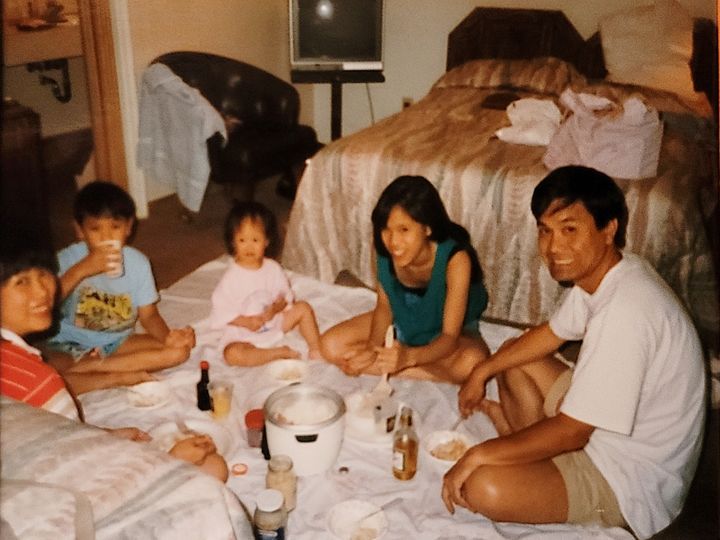
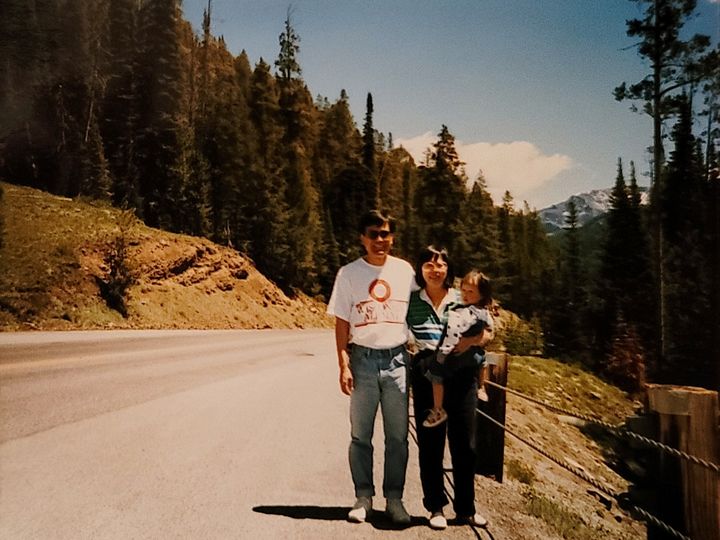
And we traveled. Mostly drove. A lot. When I was two, my family drove cross-country and back again, plugging in our rice cooker in motel rooms and spreading out to eat on the floor. We drove to DC to see cherry blossoms, to Virginia to visit family friends, to Vermont to see the leaves change, to North Carolina to go to the beach. By “we,” I don’t mean the six of us drove in shifts; I mean my dad, who drove until he got tired, napped for an hour while my mom took over, then took back the wheel. My dad hates when other people drive because he gets motion sickness and because he likes control, both traits I inherited. Another reason it seemed strange that my dad was so keen to call a cab in Fukuoka.
The day I realized the people who raised me were mutable was the first time I saw my dad impulse shop. We had been using the same TV as far back as I could remember. We were at Costco, walking among the electronics for fun, like we always did.
Standing before a row of flat-screen plasma TVs, which had recently become popular, my dad said suddenly, “Let’s get this one.”
It didn’t fit in the car, a completely manual 1993 Toyota Tercel whose back windows did not open and whose front door was shorter than the height of the box. A man saw us struggling and offered to take it in his truck. My father agreed—who was this guy, smiling at and accepting help from white strangers?—and we raced home, giggling about what my mom was going to say, checking the rearview mirror every few minutes to see if the guy was still behind us.
“Memorize the license plate,” my dad said through unrestrained giddiness.
From 1991 to 2010, my parents were in a near-constant state of writing checks to colleges. A few years after I finally graduated, the last of the four, my mother retired with forty years of pension from AT&T. To my ongoing disbelief, they do not seem to think we kids have a similar due to pay. “As long as you’re happy,” a phrase I am certain was never said (or thought) in my presence as a child, has suddenly become a refrain whenever one of us is in crisis or about to spend an unwise sum. The currency absent in my youth—that is, money—seems to flow easily. It was The Wizard of Oz in reverse: I pulled back the curtain on my fashion-agnostic, Costco-worshipping, suburban hoarder parents, and underneath was a chilled-out, sunglasses-wearing dad scrolling on his tablet looking to lease a Tesla.
Retirement brought on a new era of travel for my parents. After I spent a year in central Turkey, I met up with my parents in Istanbul, along with my brother and his wife, who were in town for a wedding. I shuttled my parents to mosques, zipped them back and forth on ferries across the Bosphorus, hurried them out for a day trip to Bursa.
On that trip, my parents got nearly scammed by a shady hotel manager, and my father got pickpocketed, losing five hundred dollars’ worth of Turkish lira and his driver’s license. We were going to Berlin next, where the younger of my two sisters was living. My father had made several mentions of driving to Scandinavia via a ferry for the summer solstice; now without a license, he ruefully said we couldn’t go.
As I sat on the bus to Bursa, my sixty-five-year-old father snoozing audibly in the seat behind me, I decided he was secretly relieved not to have to party for twenty-four hours under a midnight sun. He was tired and would never admit it. My parents were old and vulnerable to harm. It was time to take seriously the last years we had left.
That is not, of course, how they saw things. For the next decade, my parents perfected their predeparture checklist and their selfie skills. The first time I went to Japan, it was as a tagalong on their bus tour. All three of us were overcome by the trip. My parents remarked about all the things they’d do next time they were in Japan. Next time?
That turned out to be their first of three trips to Japan in five years. One of the major tenets of our house is “Life is long.” In Vietnamese, “Đời còn dài” is more like “Life is long yet.” This is trotted out for breakups, career pivots, fertility complications. It’s especially handy for missed opportunities: Didn’t wake up early enough for the fish market on your one day in Tokyo? Life is long. Crappy weather on the hike you took three busses to get to? Life is long. Got beat out for your dream job by a white man-child after hours of unpaid work? Hey, man, life is long.
In the 1960s, my mother was in high school in the city of Cần Thơ. She dreamed of leaving the country, but her only chance would have been a scholarship. I asked recently if she’d wanted to go to the US in particular, and she responded with some force: “I just wanted to go abroad! It didn’t matter where.” After my parents were married, my father got as far as Missouri on a pretty poorly paid fellowship to study applied math. It was 1974 when he left. When the loss of South Vietnam was imminent, desperation, wiles, and luck , in that order, launched my mother and oldest sister, less than a year old, onto one of the cargo planes leaving Sài Gòn in the last four days of the war.
They reunited in the US; they studied; they worked. They didn’t stop until after the last of their kids was clutching a bachelor’s degree. I didn’t know much about my mother before then. My parents were a unit, and in truth they were basically both my dad. My father ruled over the house, morally, legally. He was judge and executioner, sensei and priest, CFO and head mechanic. The two things that scared me the most as a kid: my father, and my father dying.
In the background, my mother worked steadily, did most of the cleaning and all the cooking. Only in retirement did I see her individual verve. She took up piano, sometimes plunking for four hours a day; went to the gym daily for yoga, Zumba, belly dancing, senior fitness; got certified to do taxes as a volunteer for low-income families; with my dad, became a leader at the local Vietnamese Buddhist temple, an hour and a half away; started reading the New York Times front to back and becoming very critical of the government.
My father had a friend who dropped dead in the middle of a tennis game at forty-nine years old. “That’s the dream,” he likes to joke. My parents of course do not wish to die, but the topic of death has never been morbid or taboo in our house, never broached with a reluctant, hushed mumble and euphemism as I imagine it is in other families. The other oft-repeated pillar of my upbringing is a doctrine from Buddhism: “Life is impermanent.” This, too, is handy for breakups, general suffering, and, most recently, global crises.
My parents lived through two successive wars by the time they were in their late twenties. A year after they got married, they were separated for ten months, during a time when an international phone call was simply an impossibility. In the last year and a half, cut off from the people I loved, I languished. Alone in Japan, I wondered if my parents were suppressing a great deal of post-traumatic stress from their youth. I’ve yet to consult a professional, but by the subjects’ self-diagnoses: Nope!
“There had always been war, since before we were married,” my mother said recently. “I lost people who died fighting in the jungle, but at some point we just had to get on with living.” When the pandemic hit, barred from trips, parties, and the gym, my parents muddled through the boredom. But as I despaired over video calls, they were steadfast.
“Life is—”
“I know,” I said, cutting my father off.
As soon as they were vaccinated, my parents started looking for flights. Their optimism that the world’s borders could be traversed with the right passport and enough money was dusted off from storage and put back on the mantle. In the spring, unsure if I’d be able to make it home for another year, I speculated about what would happen to all my stuff if I visited the US and couldn’t get back into Japan after.
My mother reassured me they had booked a cruise to see the leaves change in Japan in October. “We’ll just pick your stuff up for you,” she said, seemingly oblivious to the fact that her will to travel was not the cornerstone of Japan’s immigration policy. (The cruise, to no one’s surprise, was canceled.)
One morning in Busan, my parents and I took a bus to Haedong Yonggung Temple, which sits on the edge of a cliff over the sea. We wound our way along the entrance path, thronged by tourists. My father stopped and looked up. “I feel like we’ve been here before.”
That was impossible; it was the first time my mother and I had been to South Korea. We walked around some more, prayed, took photos at odd angles to make it easy to crop out other people.
After some time, my mother said, in slow agreement, “I think we have been here before.”
We were standing in front of a row of statues, each with a different animal head representing the signs of the zodiac. My mother was standing next to her sign, the pig, posing for a photo that already existed on a hard drive somewhere.
My parents were refugees who arrived in the United States with next to nothing. Before she was airlifted out of her home country, my mother had only left its borders once. They had now been to so many places in the world they had forgotten all together that, on a cruise a few years prior, they had stopped at this very spot.
“Life is impermanent” viewed in another shade sounds like “Life is short”—but, as you may recall, life is long. The two ideas fit snug, hugging head to tail as part of one whole: You can change everything; everything can change on you.
On their last night in Fukuoka, I took my parents to an onsen tucked into a mountain outside of town. We had spent the day in the sun taking photos with October flora on a sandbar park in Hakata Bay. My parents knocked out easily on the bus, and I continued plucking at the chord inside that said I was pushing them too hard.
As my mom and I headed for the baths, I realized, unhelpfully, that maybe I actually didn’t like onsen much. I had been to a mixed-gender public bath in Taipei once with some friends, and it was fun to watch the old folks whipping themselves and crowding into the human boil. But here at this little mountain spa, it was too calm, too lovely. I sat fidgeting in the forty-degree bath and tried to decipher the kanji describing the various ailments I was being cured of. I changed baths after a few minutes, putting my palms to my face just to feel a different sensation. I changed baths again, enjoying the shock of the icy-cold bath.
I looped back and my mom was still in the same bath, in fish pose with her eyes closed and her head thrown back. Her face emanated what struck my rubbery brain as a serenity rivaled only by the Buddha himself. She didn’t look stressed about age or mortality, mine or hers. I moved closer to her. I tried not to look at the clock and wonder if my dad was having a weird time alone on the men’s side, tried not to think about all I had to do before an upcoming four-day trip to New York, tried not to worry that everything until now had been a mistake. I looked at my mom, closed my eyes, and sank my body deeper into the heat.
Two weeks later, I flew home to New York for a wedding. Before I left, I had dinner with my parents and sisters, hugged them goodbye, and got on a plane back to Fukuoka.
That was nearly two years ago. I haven’t seen any of them since. As I write this, I’m getting ready to fly back to the US after a year that’s shaken most of my foundations and broken many. Certainly, anything can happen between now and then: A new variant could shut me in or out; I could get Covid; I could be denied boarding for a typo in my paperwork; I could die randomly, anyway, anytime, struck down by chaos and entropy.
But probably not.
Probably, I’ll make it. Probably, my parents will pick me up from the airport. Probably, I’ll have dinner with them and sleep in my childhood bedroom. Probably, we’ll keep this thing going a little while longer. After all, life is.